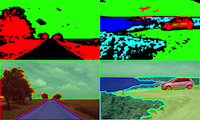
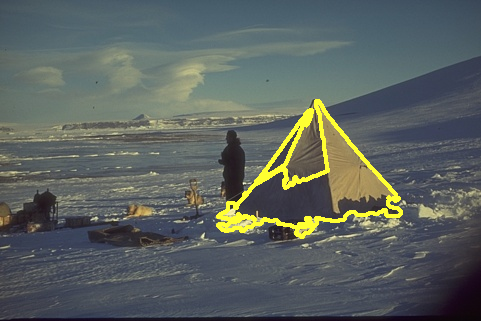
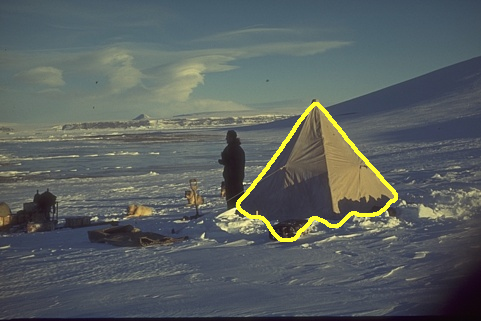
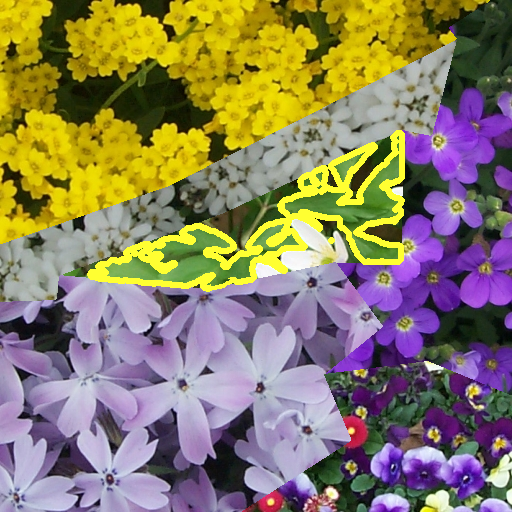
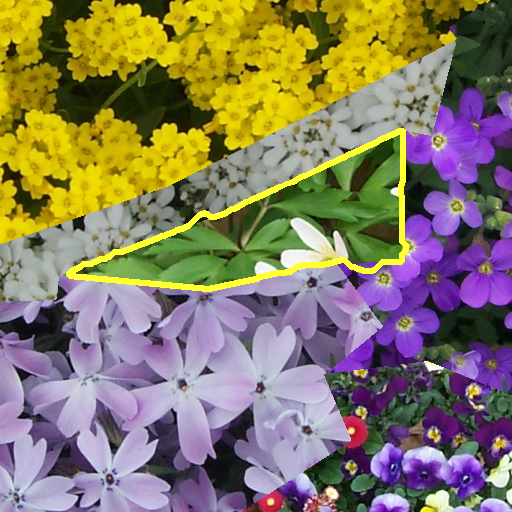
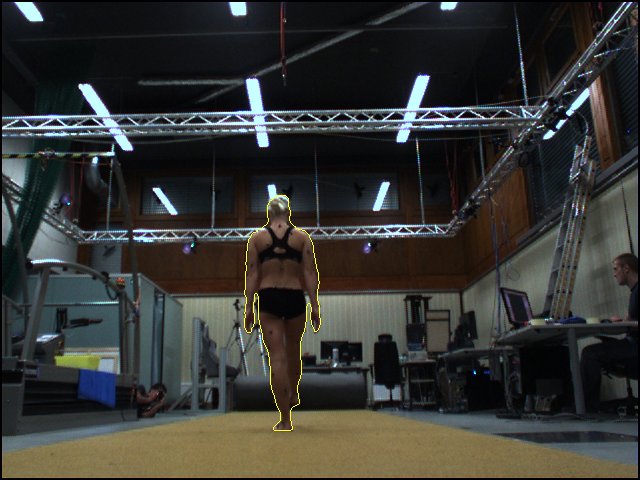
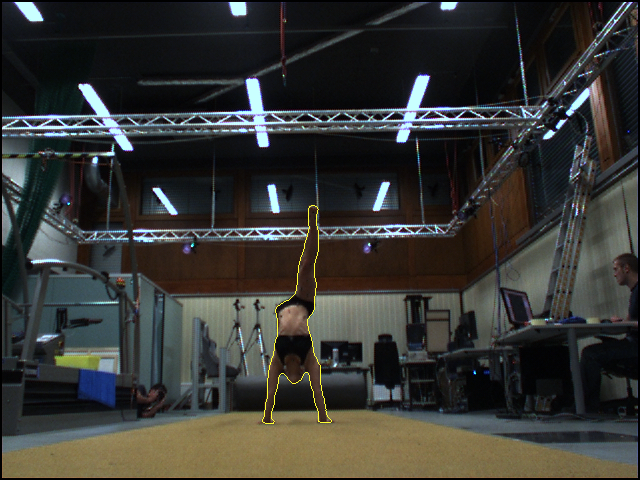
The segmentation problem is an elementary field in image processing and has been studied intensively over the last decades. The goal is to extract an object in an image or an image sequence. Thereby information contained in an image is reduced to the object of interest, which simplifies the analysis and processing of the data.
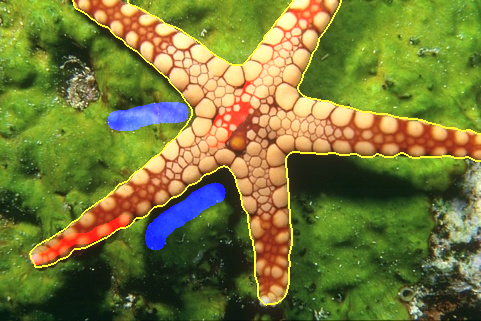
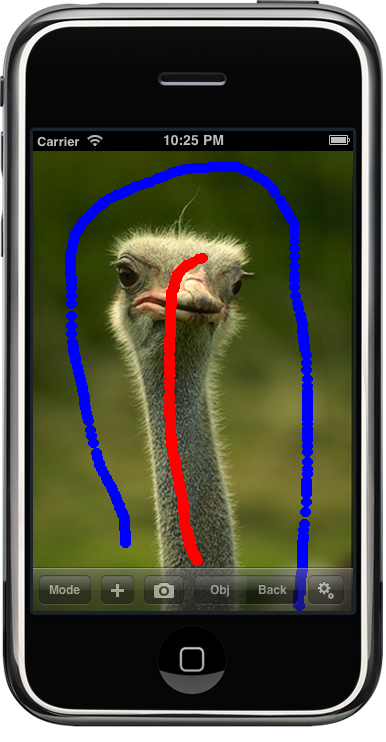

Manually segmenting complex objects in an image or an image sequence is highly time-consuming and error-prone. The goal of this project is therefore the development of an interactive segmentation scheme, which is able to segment object either in still images or image sequence by little user interactions. Therefore we need to combine several cues, like color, texture or motion, with a priori knowledge in an efficient Framework. Thus we would like to have a framework which generates a rough segmentation with little user interaction. The framework should also allow further user interaction to refine the segmentation until the object is perfectly extracted.
Classical image segmentation methods use either color and texture information (e.g. Magic Wand) or edge (contrast) information (Intelligent Scissors) to segment an object. Energy minimization methods, like the level set framework or GraphCut and accordingly GrabCut combine both information to get a qualitative better result. Both methods can also be extended to segment image sequences. However, this tends to result in a large raise of running time even if the computational complexity is the same in the number of pixels. To fuse all the different information coming from the image (color, texture, . . . ) itself or the user, we propose to use Dempster-Shafer theory of evidence. Compared with the Bayesian approach the Dempster-Shafer theory of evidence provide several advantages. Because segmentation by energy minimization is still time consuming, several algorithms are developed to reduce the computational time while the segmentation quality and the number of user interactions is preserved.
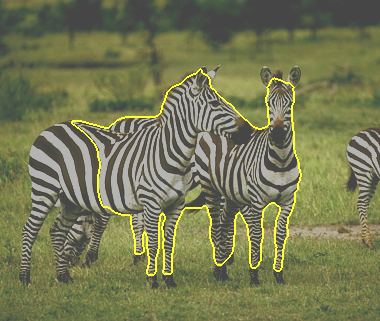
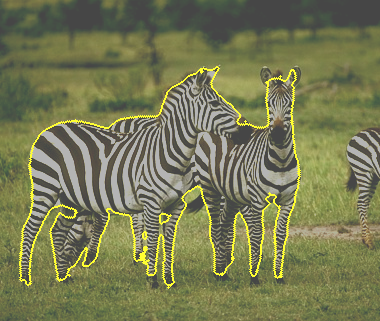
| Analysis of Numerical Methods for Level Set Based Image Segmentation In this paper we analyze numerical optimization procedures in the context of level set based image segmentation. The Chan-Vese functional for image segmentation is a general and popular variational model. Given the corresponding Euler-Lagrange equation to the Chan-Vese functional the region based segmentation is usually done by solving a differential equation as an initial value problem. While most works use the standard explicit Euler method, we analyze and compare this method with two higher order methods (second and third order Runge-Kutta methods). The segmentation accuracy and the dependence of these methods on the involved parameters are analyzed by numerous experiments on synthetic images as well as on real images. Furthermore, the performance of the approaches is evaluated in a segmentation benchmark containing 1023 images. It turns out, that our proposed higher order methods perform more robustly, more accurately and faster compared to the commonly used Euler method. (pdf) |
|
||||||
| Feature quarrels: The Dempster-Shafer Evidence Theory for Image Segmentation Using a Variational Framework Image segmentation is the process of partitioning an image into at least two regions. Usually, active contours or level set based image segmentation methods combine di erent feature channels, arising from the color distribution, texture or scale information, in an energy minimization approach. In this paper, we integrate the Dempster-Shafer evidence theory in level set based image segmentation to fuse the information (and resolve con icts) arising from di erent feature channels. They are further combined with a smoothing term and applied to the signed distance function of an evolving contour. In several experiments we demonstrate the properties and advantages of using the Dempster-Shafer evidence theory in level set based image segmentation. (pdf) |
|
||||||
| N-View Human Silhouette Segmentation in Cluttered, Partially Changing Environments The segmentation of foreground silhouettes of humans in camera images is a fundamental step in many computer vision and pattern recognition tasks. We present an approach which, based on color distributions, estimates the foreground by automatically integrating data driven 3d scene knowledge from multiple static views. These estimates are integrated into a level set approach to provide the final segmentation results. The advantage of the presented approach is that ambiguities based on color distributions of the fore- and background can be resolved in many cases utilizing the integration of implicitly extracted 3d scene knowledge and 2d boundary constraints. The presented approachis thereby able to automatically handle cluttered scenes as well as scenes with partially changing backgrounds and changing light conditions. (pdf) |
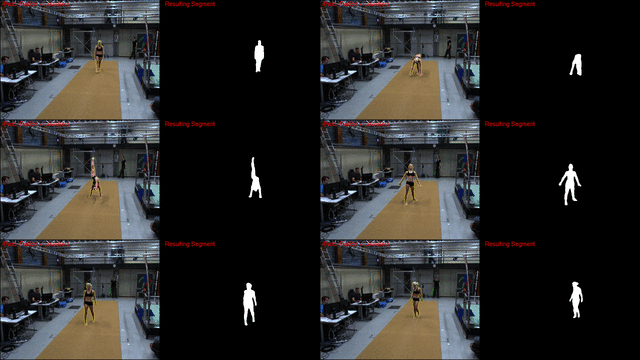
|
||||||
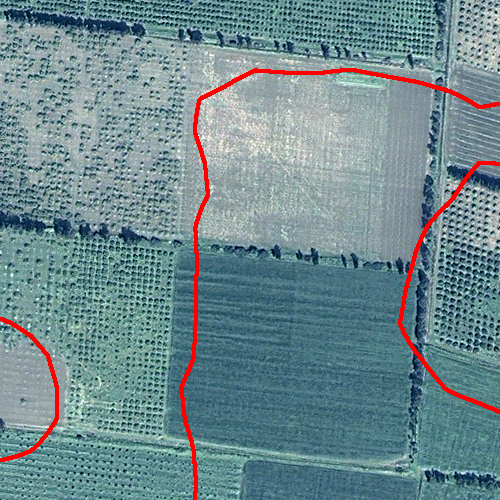
| Automated Extraction of Plantations from Ikonos Satellite Imagery using a Level Set Based Segmentation Method In this article we present a method that extracts plantations from satellite imagery by finding and exploiting appropriate feature space projections. Segmentation is done using an automatic two-region segmentation based on the level set method. The behaviour of this algorithm is defined by a statistical region model that describes the similarity of regions using distances in arbitrary feature spaces. Subsequently different feature spaces will be evaluated regarding their plantation classification quality in an automatic fashion. The segmentation quality of our method is assessed by testing several orthophotos depicting a wide range of landscape types and comparing them with a manual segmentation. We show that a combination of simple texture based features like the structure tensor and the Hessian matrix are sufficient to facilitate an effective plantation segmentation scheme. (pdf) |
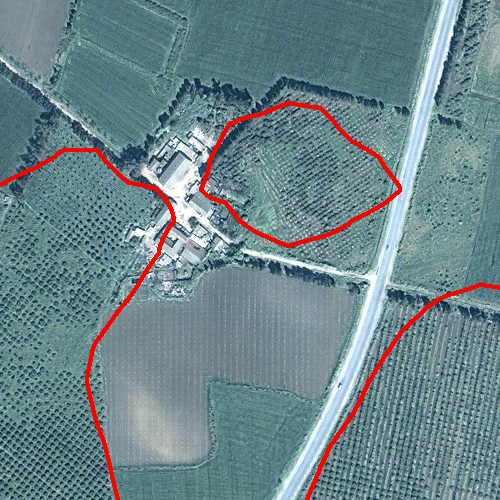 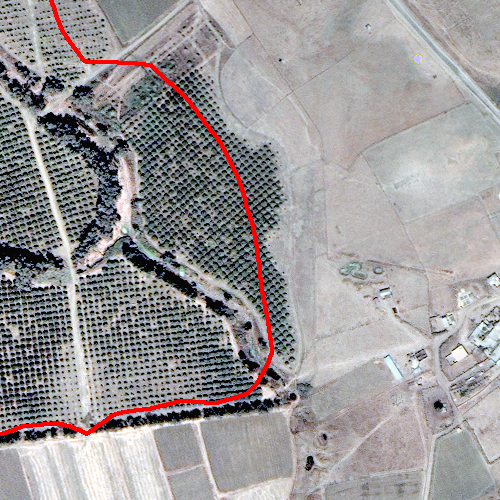 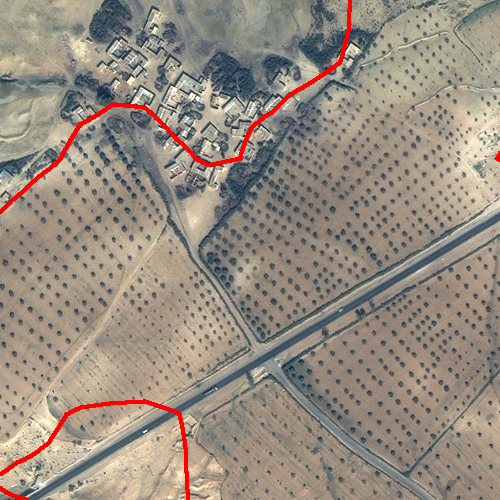  |
||||||
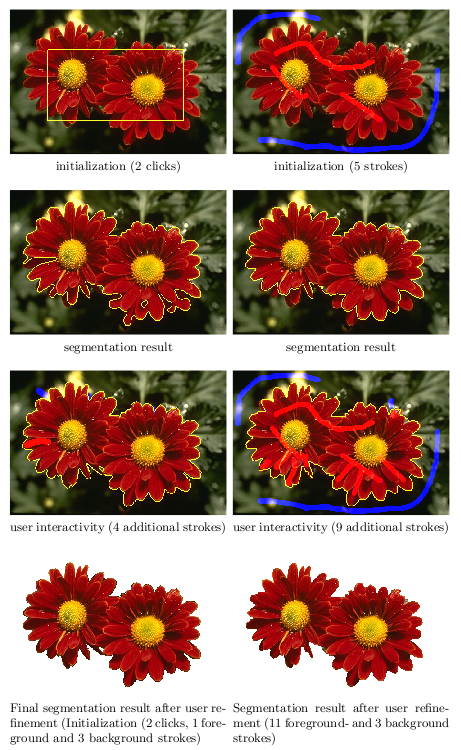
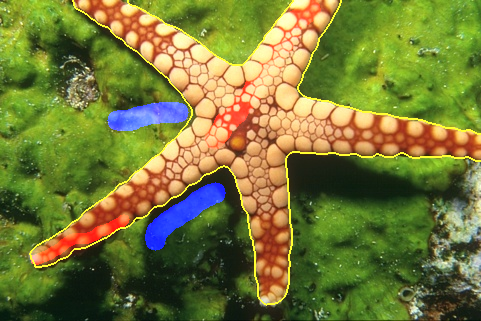
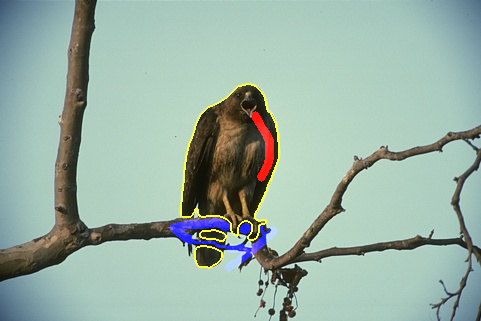
| Interactive Image Segmentation Using Level Sets and Dempster-Shafer Theory of Evidence Variational frameworks based on level set methods are popular for the general problem of image segmentation. They combine different feature channels in an energy minimization approach. In contrast to other popular segmentation frameworks, e.g. the graph cut framework, current level set formulations do not allow much user interaction. Except for selecting the initial boundary, the user is barely able to guide or correct the boundary propagation. Based on Dempster-Shafer theory of evidence we propose a segmentation framework which integrates user interaction in a novel way. Given the input image, the proposed algorithm determines the best segmentation allowing the user to take global influence on the boundary propagation. (pdf) |
   |
||||||
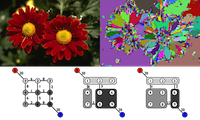
| SlimCuts: GraphCuts for High Resolution Images Using Graph Reduction This paper proposes an algorithm for image segmentation using GraphCuts which can be used to efficiently solve labeling problems on high resolution images or resource-limited systems. The basic idea of the proposed algorithm is to simplify the original graph while maintaining the maximum flow properties. The resulting Slim Graph can be solved with standard maximum flow/minimum cut-algorithms. We prove that the maximum flow/minimum cut of the Slim Graph corresponds to the maximum flow/minimum cut of the original graph. Experiments on image segmentation show that using our graph simplification leads to significant speedup and memory reduction of the labeling problem. Thus large-scale labeling problems can be solved in an efficient manner even on resource-limited systems. |
[1] Björn Scheuermann and Bodo Rosenhahn, Analysis of Numerical Methods for Level Set Based Image Segmentation, ISVC 2009
[2] Björn Scheuermann and Bodo Rosenhahn, Feature quarrels: The Dempster-Shafer Evidence Theory for Image Segmentation Using a Variational Framework, ACCV 2010
[3] Tobias Feldmann, Björn Scheuermann, Bodo Rosenhahn, Annika Wörner, N-View Human Silhouette Segmentation in Cluttered, Partially Changing Environments, DAGM 2010
[4] Karsten Vogt, Björn Scheuermann, Christian Becker, Torsten Büschenfeld, Bodo Rosenhahn, Jörn Ostermann, Automated Extraction of Plantations from Ikonos Satellite Imagery using a Level Set Based Segmentation Method, ISPRS 2010
[5] Björn Scheuermann and Bodo Rosenhahn, Interactive Image Segmentation Using Level Sets and Dempster-Shafer Theory of Evidence, SCIA 2011
[6] Björn Scheuermann and Bodo Rosenhahn, SlimCuts: GraphCuts for High Resolution Images Using Graph Reduction, EMMCVPR 2011
[7] Most images used in the papers are available at the Berkeley Segmentation Dataset and the MSRC Dataset